
A modest proposal for Andy Burnham’s first reform
First-past-the-post used to be defensible. Now it’s dangerous

Dear Andy
Congratulations on your now-certain elevation to prime minister. Like others, I have some advice. Unlike theirs, mine costs nothing. It also concerns a cause that has is dear to your heart. Here goes.
You have long wanted a new voting system for electing MPs. Instead of first-past-the-post (FPTP) you prefer a more proportional system.
As recently as this spring you told Northern Ireland’s Alliance Party conference:
“Our broken political system has created a level of alienation which has given rise to the populist right and, worse, could usher them into power on 30 per cent of the vote or even less. It is time for those who oppose this prospect to wake up and work differently.”
Top of your list of proposals for putting things right was…
“…to encourage as many parties as possible to fight the next General Election on a shared manifesto commitment to introduce a system of PR at the one after”.
That makes a lot of sense. As far as possible, a big change in the system for electing MPs should be done on a cross-party basis. Unanimity may well be impossible, but the broadest possible consensus would promote public acceptance and a lasting settlement. It will take time.
But that does not mean nothing can or should be done now. You could start the journey to voting reform before the next election. The reason for doing so flows from an urgent need to modify FPTP. This has survived because it mostly worked for many years. Historically, its straightforward constituency-based system tended to provide a clear choice of government in which MPs generally enjoyed majority local support. These factors outweighed its disadvantages: an adversarial political culture, and majority governments elected on a minority of votes.
All this was largely true from 1945 to 2005. Only one general election, in February 1974, produced a hung parliament. None gave the incoming government reached 50 per cent of Britain-wide votes, but every majority government secured at least 40 per cent support. Its right to rule was broadly accepted.
That state of affairs started to break down in 2005. Since then, only once has a majority government been elected with 40 per cent-plus of the popular vote (2019). The other three majority governments have enjoyed less than 40 per cent support (2005, 2015, 2024). In the other two elections the Conservatives were the largest party but fell short of an outright majority (2010, 2017). We now have a Labour government that came to power with almost two-thirds of the MPs at Westminster with barely one-third of the national vote.
All that leads to the familiar argument that FPTP now distorts the distribution of votes to an unacceptable degree. That distortion is the foundation of the case for a more proportional system.
You know all that. My argument here is that a new and serious distortion, far less discussed, has made the case for reform more urgent than ever.
It arises from the constitutional principle that the mandate for government flows from having a majority of MPs in the House of Commons. The democratic foundation of this principle is that every constituency is represented in parliament. As long as each MP has been democratically chosen by local voters, the legitimacy of the process has a robust defence. It is precisely what a representative democracy is all about: the decisions of a majority of emissaries from throughout the United Kingdom.
The key to all this is that local MPs are “democratically chosen by local voters”. What if that is not what happens – if it often turns out that most local voters strongly oppose the candidate they send to Westminster?
This has always been a theoretical danger of FPTP but in practice it has affected few contests. For a start, any candidate who wins 50 per cent plainly enjoys majority support – as you did last month in Makerfield. But candidates who come first with fewer than 50 per cent have a less certain mandate.
You know this all too well. Every published poll in Makerfield showed you with less than 50 per cent support. Some suggested that the combined Reform-plus-Restore vote would exceed yours. Had that been the outcome, you would still have been elected, but yours would have been a less emphatic victory. The speeds with which Keir Starmer abandoned his wish to fight on, and Wes Streeting withdrew from the fray, were helped by your achievement in securing support that comfortably exceeded not just the total of Reform and Restore but the total of ALL other candidates.
In the light of this outcome and the fact that you won, as it were, a supermajority, I have looked at the last two general elections, and YouGov’s MRP projections from last autumn. How many MPs won (or, according to YouGov, would win) absolute majorities in their local constituencies? How do the winning percentages break down for MPs with less than 50 per cent support?
Here are the figures.
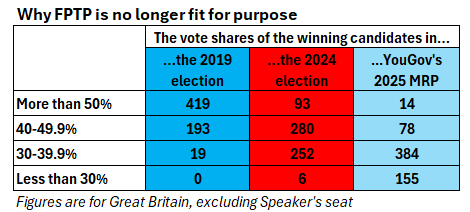
Back in 2019, almost two-thirds of MPs enjoyed the support of an absolute majority of local voters. Today, fewer than one in six MPs can make that claim. You are one of a select minority.
The next band – 40-49.9 per cent – consists of MPs who could claim a fair degree of local support; only those who have small majorities would be at risk from a different voting system. Under 40 per cent and the claim to popular appeal is weaker. In 2019 there were just 19 of them. Two years ago that number exploded to 258, of whom six won with less than 30 per cent.
This eruption is one of the consequences of fragmented party competition, with Reform and the Greens gaining ground, and the combined support or Labour and the Conservatives falling to their lowest ever share. We can‘t be sure how many of the 258 would have won under a preferential system. That’s precisely what should worry us. A representative democracy needs more certainty that each MP truly represents the communities that elect them.
Since the 2024 general election, our politics have fragmented further. If the pattern of results two years ago revealed FPTP’s failings at local levels, its operation at the next election is likely to be even less defensible.
The seat-by-seat MRP estimates indicate well over 100 MPs would be elected with less than 30 per cent support. (Since then, Reform has lost support; and there is anyway a large margin of error in MRP figures for individual seats. However, the overall distribution of winning percentages is likely to be similar, and possibly even worse, when five parties jostle in the range of 12-26 per cent across Britain.)
On YouGov’s figures, fewer than 100 would pass the 40 per cent mark, with merely 14 of them winning 50 per cent. In 2019 an overwhelming majority of MPs either won more than 50 per cent or came sufficiently close to be the undoubted winner had they fought under a different system. Ten years on from Boris Johnson ‘s victory, FPTP would send to the House of Commons dozens, perhaps hundreds, of MPs who would struggle to win under a fairer system.
Preferential voting would help to sort this out. Voters would decide not just their top choice for MP, but their second and (depending on the precise system) subsequent choices. The main political parties have preferential systems for choosing their parliamentary candidates and their national leaders. If we extended the principle to the way we elect MPs, more than 500 candidates elected in 2024 would have fallen short on the first count.
There is a further point. FPTP versus preferential voting is not just about numbers. It is about the way we do politics. As you said in your speech on Monday, Britain needs “a more collaborative politics. problem-solving, not point-scoring”. You promised to “reach out to other political parties to find as much common ground as we can “.
Preferential voting rewards the kind of politics you favour. Locally, it encourages candidates to court the supporters of other parties, in order to attract their second choices. Nationally, it encourages parties to find common ground. Parties that refuse to compromise and insist on the purity of their cause can prosper under FPTP far more easily than under a preferential system. Yes, Nigel, I’m looking at you.
There are two straightforward ways to reform the way we vote while sticking to single-member constituencies. One, which has worked well in Australia for more than 100 years, is the Alternative Vote (AV). People can put 1 against their first choice, 2 against their second choice. 3 against their third choice, and so on. This was the system rejected here in Brtain by a referendum in 2011.
As the statistics above illustrate, the case for FPTP is far weaker than it was – and the need to replace it more urgent. Fifteen years on, the referendum vote has lost its right to veto change.
The second system is the Supplementary Vote (SV). It operates like AV, but allows voters to mark only their first and second choice. In practice, the difference between the two systems is marginal. The incentive to operate a less confrontational politics applies to both. Candidates who fall short of 50 per cent on the first count still need to woo voters from beyond their party’s own ranks. Consider last year’s Runcorn and Helsby by-election, which Reform’s Sarah Pochin won by six votes. Labour’s Karen Shore could well have attracted enough “stop Farage” second preferences to deny Reform its victory.
Politically, the advantage lies with SV. It’s already in operation. When Tony Blair’s government introduced mayoral elections, this was the system it chose. The Conservatives scrapped it four years ago and reverted to FPTP. The current government has revived it. SV does not guarantee that the winner has the support of a majority of voters, but it comes close.
The revived SV system will be used for the first time to choose your successor as Greater Manchester’s mayor. Normally such an election, and the system employed to decide its winner, would attract little national attention. But it coincides with your arrival in Downing Street as greatest advocate of proportional voting that Number 10 has ever seen. There is no logical reason why the system that is right for the first electoral test of your premiership should be wrong for electing MPs.
This proposal to extend SV to parliamentary contests is specifically for the next three years. It tackles the urgent need to repair the current defects in FPTP at constituency level and reduce the danger that you pointed out of a populist government coming to power with 30 per cent of the vote or less.
Your work to build a cross-party consensus for manifestos at the next election remains necessary. Indeed, by introducing SV now you will demonstrate the seriousness of your commitment to reform, both to other parties, and to the wider public. It’s not that many voters care about the specifics of electoral systems – rather that they will warm to a leader who shares their wish to suck the poison from politics and who has clear plans for doing so. SV might be a one-general-election system pending greater change. It would still have an honourable, and possible vital, place in the story of progressive reform.
There is no better time to start the journey than in the month when SV is used to fill your shoes in Manchester, and the month after you have personally demonstrated the benefits of having a clear majority of local voters on your side.
Good luck!
Peter
That's one incremental way of introducing preferential voting.
The other way would be to standardise voting in local and regional government to STV, as used for the assembly in Northern Ireland, and Scotland. Then, at a subsequent general election, promise to implement STV at Westminster
Brilliantly argued, and thank you for those eye-opening figures about how unrepresentative MPs are becoming under the current system!