
Burnham’s bounce: will it last?
Reform’s slump is just as important as Labour's vote share

Labour has probably edged ahead of Reform. Sorry about the “probably”. I suspect I have broken some writer’s rule that it conveys weakness and should never appear in the first sentence. But here it matters. Polls seldom agree precisely with each other; and of the five polls conducted since last Friday, two report modest Labour leads while the other three say Labour and Reform are level-pegging.
As always, the best way to work out what is happening is to average a cluster of polls – and to compare the figures of the same clusters over time. This gives us like-with-like comparisons.
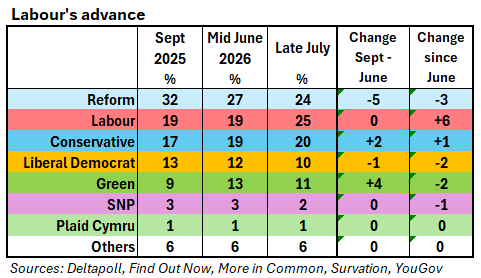
The polls show the benefit that Andy Burnham has gained from his frenetic political honeymoon, when daily policy announcements have dominated the news. The reality is that most voters will take weeks, possibly months, to come to a settled view about our new prime minister. Even so, there are important clues to what is going on, even if we can’t be sure where we shall all end up.
The first is that Labour’s recent rise has accompanied a continuation, and possibly acceleration, of Reform’s steady decline. I discuss Reform’s position in more detail below, as it affects the whole political landscape. For the moment, the Conservatives have as much reason as Labour to rejoice. It has been barely noticed, for the sampling fluctuations in month-by-month figures outweigh monthly variations in underlying support. But since last autumn, the Tories do seem to have climbed from the mid-to-high teens in percentage support to twenty-plus.
The second is that the Burnham bounce has dented support for the Greens and Liberal Democrats (though individual polls disagree on which has been hurt more). Labour has made some progress towards its strategic objective of dominating the progressive vote.
The third point flows from the first two. Month after month the combined support of Labour and Conservative floundered below 40 per cent. It is now 47 per cent. Meanwhile, the insurgency vote, for Reform and the Greens, which peaked at 40 per cent this spring, is now down to 34 per cent.
Fourth, there is a contrast between the polling trajectories of parties and their leaders. Over the past nine months, Kemi Badenoch’s personal ratings have risen sharply. Averaging the polls, the number satisfied with her has almost doubled. Yet her party has risen just three points to 20 per cent. Labour’s change of leader has produced an almost identical rise in personal approval compared with Keir Starmer’s – and, by the end of Burnham’s first week as prime minister, a six-point advance in party support. Once again party support has lagged personal appeal.
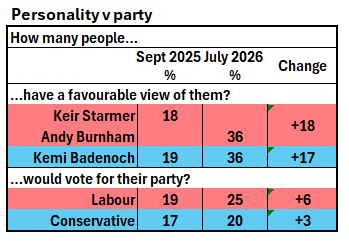
The reason is not hard to find. Both parties are weighed down by dreadful brand reputations. The Conservatives have yet to be forgiven for their failings in office. Likewise, voters have taken against both Starmer and his government. Labour’s current 25 per cent is better than 20, but well short of what it needs to be sure of an overall majority at the next general election Like Badenoch, Burnham needs to persuade voters that he offers not just a better driver but a better car.
If he succeeds, there are reasons for optimism. For the past year, Reform has been the greatest threat to Labour prospects. That threat is fading. Nigel Farage’s party peaked last autumn when its polling exceeded 30 per cent for some weeks. It has now slipped to 24 per cent.
This is as important to Labour and the Tories as to Reform. Our first past the post voting system (FPTP) has two features that are especially significant. The first is that a crowded political marketplace enables a party to win an overall majority with around one-third of the national vote. Labour showed that two years ago.
The second feature of FPTP is particularly relevant to Reform. Think back to the last general election. The Liberal Democrats trailed Reform by 600,000 votes (3.5 to 4.1 million votes) but trounced it in seats (72 to five). This was because the Lib Dems piled up votes where they could win, but relatively few where they couldn’t. In contrast, Reform’s vote was spread far more evenly. It won between 15 and 25 per cent in as many as 284 seats – votes that boosted its national total but gave it no MPs. Only 35 Lib Dem candidates ended up in that wasted vote territory.
For a while last autumn, when Reform was at its peak, its 18-point rise in vote share since 2024 converted the great majority of those 284 seats from far-behind to first place. Evenly spread votes ceased to be a handicap and became a huge asset.
Yet what FPTP gives, it can easily take away. A YouGov MRP survey last September, which projected 311 seats for Reform when it was at its peak, said that 82 of those seats would be won by less than five percentage points. It would take only a modest dip in support to rob the party of hopes of glory.
This seems to be happening. Shortly before Starmer’s resignation, two MRP polls by separate companies produced startlingly different figures. We could be forgiven for viewing the gulf between them as a reason to dismiss all MRP projections. In fact, they tell us something crucial. Here are their figures:
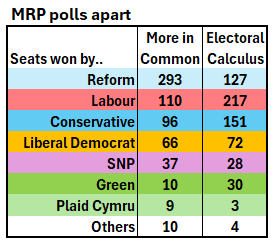
Take your pick: Farage becoming prime minister, not far short of an overall majority (More in Common).; or Burnham leading comfortably the largest party, with the chance to lead a progressive coalition working with the Lib Dems and the Greens (Electoral Calculus)
Why are the two projections so far apart? You might think Labour’s overall vote is much higher with Electoral Calculus. You would be wrong. Its figure is just one point higher: 22 per cent rather than 21.
Part of the difference is that Electoral Calculus makes a tactical voting adjustment. This costs Reform 39 seats and the SNP 11, while Labour gains 22, the Tories 27 and the Lib Dems one.
However, most of the difference comes from the list of parties the two companies offer respondents. Electoral Calculus includes Restore; More in Common does not. Whereas Electoral Calculus has Reform on 22 per cent and Restore on seven, More in Common simply shows Reform on 28 per cent. They pretty well agree on the size of the hard right vote, but disagree on whether it is monopolised by one party or shared between two. (They agree almost exactly on the figures for all the other parties.)
Mr Micawber would appreciate Farage’s position. Twenty-eight per cent: result happiness; 22 per cent: result misery. And misery for Farage brings joy to Burnham and Badenoch.
Today, Reform is closer to 22 than 28 per cent. Small shifts in either direction would have big political consequences. If Reform dips a little lower, Labour has a good chance of being the largest party at the next election.
All in all, an early bounce is neither here nor there. To exploit any further weakness in Reform, Burnham’s better car needs to be charged up for a long drive, not a just spin round the block.
This post updates an article published earlier this week by the New Statesman https://www.newstatesman.com/politics/uk-politics/2026/07/labours-lead-may-not-last
If these trends continue, Farage might start talking about PR again (he was very quiet about it the last 12 months), and Burnham will stop talking about it.
By your last paragraph are you suggesting Burnham would be wise to go long with next GE thus giving himself a chance to show car IS better & also not get in the way while Farage & Reform continue to flounder, make errors & be subjected to media scrutiny?
Driver Andy