
Greens humiliate Labour: five take-aways from yesterday’s by-election
A terrible result not just for Starmer, but for Britain’s political mainstream

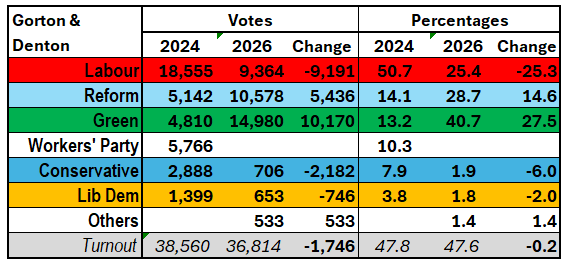
1. Hannah Spencer’s victory is sensational. Before last night, the Greens’ best by-election performance was 10.2 per cent in Somerton and Frome three years ago. Last night they won four times as much support. Gorton and Denton will join the roll call of constituencies that have humiliated unpopular governments this time with a new name added to the list of triumphant parties.
Perhaps the nearest equivalent is Brent East in 2003. Labour had won by a mile in 2001; the Liberal Democrats scored just 10.6 per cent. Sarah Teather won the seat for the Lib Dems on a 29 per cent swing. An overwhelmingly left-of-centre electorate found its way to punish Tony Blair following the Iraq war.
For Brent, read Gorton (where Labour lost on a swing of 26 per cent); for the Lib Dems read Greens; for Iraq read Gaza.
Last night, Spencer benefitted from the absence of an alternative left-wing candidate in a seat where 30 per cent of the electorate are Muslim. (In 2024, the Workers Party of Britain won 10 per cent. They did not stand yesterday.)
Blair never regained his lustre after the Iraq war. However, Labour did win the 2005 general election, albeit with a reduced majority, Keir Starmer or his successor could live with national politics post-Gorton following the precedent of national politics post-Brent. Well, it’s a flash of hope in the dark.
The big question – more accurately, one of a number of big questions – is whether Gorton and Denton will be blip in the story of British politics or the start of a lasting trend, taking the Greens into the big time
2. Reform may have peaked. Recent nationwide polls give a mixed picture, but the average has tended to drift slightly down. In the autumn, most polls showed them on or above 30 per cent. This month, most have put them below 30 per cent.
Last May, Reform captured Runcorn and Helsby with 38.7 per cent of the vote, up 20.6 percentage points compared with 2024. Last night’s performance fell short of that: it won 28.7 per cent, up 14.6 points.
That said, it was still a notable achievement. Should we be impressed by a glass half full because it was almost empty two years ago, or mark it down because it’s not quite as full as it was?
This is not just a question of stretching a metaphor. In a general election, 30 per cent across Britain would almost certainly be enough to make Reform the largest party in the new parliament. However, it would win many seats with small majorities. For every point is falls below 30 per cent, its prospects fade. On 25 per cent it would trail in second place. On 20 per cent it could come a poor third. Reform cannot afford to slip significantly from its current support.
After last night, the question for Reform is the mirror image of that for the Greens: is its failure to win evidence of a blip or a trend?
3. For Labour the result is plainly catastrophic. Indeed, its 25.3 point drop since 2024 understates the scale of its disaster. In 2019 it won 67.2 per cent, then lost 16.5 percentage points in 2024, mainly due to the intervention of the Workers Party. In as far as Muslim voters have deserted Labour, much of the desertion had already happened two years ago. What happened last night cannot be fully explained by Gaza.
Nor does a fall in turnout explain Labour’s plight. This has often been cited in the past to argue that supporters stay at home in the by-election but return to the fold for the following general election. This time, turnout was almost the same as in 2024. To be sure, some former Labour voters will have stayed at home, while Reform and the Greens picked up some new voters. But the lion’s share of Labour’s 9,000 lost votes did not stay away: they switched to other parties.
There is quite separate evidence of the depth of the hole in which Labour now finds itself. Week after week by-elections are held for local councils. More than 200 have been held since last May. Greg Cook, Labour’s former head of political strategy, and Mark Pack, a Lib Dem peer and meticulous number cruncher, tell the same story. Labour has failed to gain a single seat, and lost three-quarters of the seats it was defending.
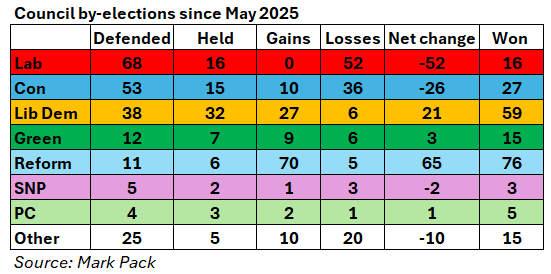
If the local elections this May show anything like this pattern of gains and losses, Labour will be in even more dreadful trouble. The Tories will also be unhappy. After last night, one intriguing question is whether the Greens will take votes from the Lib Dems. If so, will Ed Davey’s party make fewer gains than it must have been expecting? And will the Greens achieve a big jump in seats, not just votes, outpacing the steady progress it has made in recent years?
4. It is rare in the extreme for neither Labour nor the Conservatives to come in the top two. It happened in Rochdale in February 2024. That was won by George Galloway of the Workers’ Party; Labour disowned its candidate. Put that unusual contest on one side and Gorton and Denton is in a class of its own.
Put another way, the two insurgent parties, Reform and Green, won almost 70 per cent between them. The Labour/Conservative total was just 27 per cent. When all the factors are taken into account – the Muslim vote, the intensity of local campaigning, the chance for voters to let off steam when they are not choosing the government and so on – this result feels like the biggest threat yet to a century of Lab-Con domination of British politics.
5. Finally, a modest plea to my Labour friends. Yesterday morning, party members received an email in the name of their by-election candidate, saying the contest is “going right down the wire between Labour and Reform”.
Meanwhile voters were sent a party leaflet claiming to report a poll by “Britain Predicts”, showing Reform on 32 per cent, Labour on 31 and the Greens on 28. It cited an organisation called “Tactical Choice” advising those who want to defeat Reform to vote Labour.
I have never heard of “Britain Predicts” or “Tactical Choice”. Nor has Google. If Labour had news of a genuine poll showing the Greens lagging in third place, the party would surely have told journalists and given them full details. Is its failure to do so evidence of gross incompetence, or can we think of another explanation for what happened? Whichever minister has the luckless job of defending Labour over the weekend, I hope they are asked to explain who “Britain predicts” and Tactical Choice” really are.
We should, of course, not be too squeamish about rough and tumble tactics in a tight contest. But outright lies cross a line that democrats should defend. If by some chance the figures in that tactical voting leaflet were not from a genuine poll, I appeal to my Labour friends to change their ways – not for reasons of moral purity but out of self interest. The mainstream parties are struggling for all sorts of reasons, but among them is a wide suspicion that they don’t tell the truth. The more cynically the traditional parties behave, the more they drive voters into the arms of the populists on the left and right.
One of the very few things that Tony Benn got right was that he refused to discuss publicly how any campaign of his was going down with voters. He said candidates should explain what they stood for, leave constituents to make up their minds, and wait for the result. For once, Labour should follow Benn’s lead.
Hopefully this result will lead to the BBC giving the Green Party the ongoing coverage it deserves rather than continuing to spout Farage’s private company’s propaganda.
This result confirms that there are now no safe seats in Westminster . MPs should change the voting system to AV as it will provide some stability to a 5 way party system .