

Politically, are you a bit down these days? Feeling that last year’s election result has turned sour? That glad confident morning is a distant memory? That Britain these days is in as big a mess as ever? That neither Labour nor the Tories understand where they have gone wrong?
If so, you are not alone. Reform’s consistent lead in the polls is a product of widespread disenchantment with both the government and the official opposition. Despite that, there is a temptation, especially among the loyalists of both parties, to trust that things will improve. There is time to recover, as both parties have in the past.
Maybe one or both will. But history warns against such optimism. Last year’s election was the seventh in sixty years to lead to a change of government. What has happened this time is out of line with the other six to a degree that should terrify both Labour and the Tories. And it’s not just the latest controversies over Angela Rayner’s resignation and Peter Mandelson’s sacking. Trouble was baked in from the very beginning. Early missteps by Keir Starmer and Rachel Reeves, and the Conservatives’ choice of leader to succeed Rishi Sunak, have merely made a bad position even worse.
To get to the heart of the matter, I have borrowed the economic concept of the “misery index”, devised by Arthur Okun, an American economist. He proposed a simple but powerful indicator of the health of a nation’s economy: add together the percentage rates for unemployment and inflation. Currently, the UK’s misery index stands at 8.5 – the sum of a 4.7 per cent unemployment and 3.8 per cent inflation. It’s too high. The government – any government – would like it to be around 5, with a 3 per cent unemployment rate and 2 per cent inflation rate.
For its political equivalent, I have calculated a “respect index”. It measures the political health of the leaders of the two main parties at Westminster, by adding their net satisfaction rates. I have done this for the run-up to each of the last seven elections at which power has changed hands, and then 12 months afterwards.
For example, at the start of the 1964 election, Gallup found that 59 per cent of the electorate thought Harold Wilson was doing a good job as Labour leader, while 24 per cent said he was doing a bad job. So Wilson’s net rating, good minus bad, was plus 35. Alec Douglas-Home, the soon-to-depart Conservative prime minister, enjoyed a rating was plus 8: good 46 per cent, bad 38 per cent. Add together the two ratings, plus 35 and plus 8 – and the respect index stood at plus 43. Overall, when the index is positive, there is widespread contentment with the choice available to voters. Trouble arrives when the index is negative – and the more negative the index goes, the more dissatisfied voters are with their choice.
The tables below show the figures for each of those seven change elections, both at the start of the campaign, and one year after the new government took office.
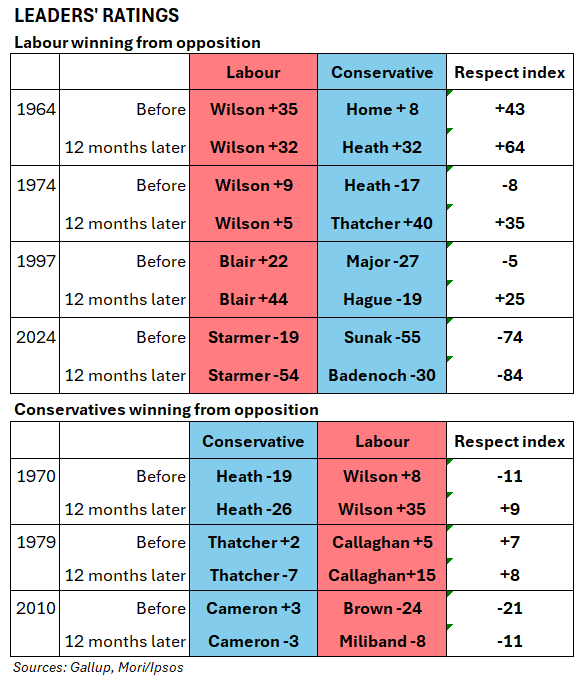
Before last year’s election, the worst respect index around a change election was minus 21. This was at the start of the 2010 campaign, when Gordon Brown’s bad rating, minus 24, outweighed David Cameron’s plus three. The Tories, of course, failed to secure an overall majority and had to bring the Liberal Democrats into a coalition government.
Last year’s election shattered that record, with Rishi Sunak’s catastrophic rating of minus 55, compounded by Starmer’s minus 19. These figures contributed to the weak voting totals of both their parties. But because the 36 point gap between the two leaders was so great (exceeded only by the 49 point gap between Tony Blair and John Major), Labour cruised to its loveless landslide.
Since then, the respect index has worsened to minus 84. For the first time, the index has deteriorated since a change election. Starmer’s figures on his first anniversary as prime minister were virtually identical to Sunak’s last summer, while Kemi Badenoch’s arrival has merely revised the public verdict on her party’s leadership from catastrophic to terrible.
Last year was not the first time that a Prime Minister has gained power with a negative personal rating. It has happened once before: Edward Heath in 1970. This is not a happy precedent. Heath was the only one of the previous winners in this series to be defeated at the following election.
Nor is this the first time when both the new prime minister and opposition leader have been in negative territory 12 months into a new parliament. Cameron and Ed Miliband suffered that fate in 2011. But they were only just on the wrong side of parity. Their ratings of minus three and minus eight produced an overall respect index of minus 11 – a far cry from this year’s minus 84. Otherwise, after every change election from 1964 to 1997, the overall one-year index was positive, with at least one leader, and on two occasions both, having a positive score.
That said, only Blair saw his popularity rise after being elected prime minister, jumping 22 points to plus 44 in May 1998. Pre-Starmer, the rest saw their ratings slip during their first year in Downing Street – but not much: Wilson after 1964 by three points and after 1974 by four, Heath by seven, Thatcher by nine and Cameron by six. Starmer’s 35 point descent, from minus 19 to minus 54, is in a far more disastrous league.
With voters so disenchanted with both Starmer and Badenoch, no wonder that so many have shifted to smaller parties. MPs past and present, too. Danny Kruger’s defection from Tory to Reform may not be the last. But are we witnessing no more than a short-term, if dramatic, blip, or have voters made up their minds, with no way back for either leader?
In his latest Substack, Philip Stephens puts the optimistic case, for Starmer at least. He says polls are snapshots of the present, not infallible guides to the future. The next election could be almost four years away. Stephens thinks that “the chances of the Reform leader walking into 10 Downing Street are as close to zero as to make no difference” and that Starmer remains the favourite to be re-elected.
Stephens is plainly right that polls are snapshots. They don’t tell us everything. But neither do they tell us nothing. And what they have been telling us month after month is much the same. At the start of this year, a case could be made for saying that both Starmer and Badenoch were on probation, and that firm verdicts from an unhappy electorate were not yet it. Now they are. Something extraordinary will have to happen for either leader climb out of the hole they are in.
As for the next election, I think Stephens understates Farage’s prospects. I agree that his chances of becoming prime minister are low; but they are not negligible. The bookmaker, William Hill, puts the odds as short as 5/2. This is equivalent to a chance of almost 30 per cent: a remarkable figure when Reform has just five MPs. But even if the true likelihood is more like 10 per cent, that’s too high for comfort.
Politics is a rough trade. Talent, decency, hard work and devotion to the most laudable principles are not always rewarded. But parties cannot afford to be sentimental. The lesson from the polls, and from the comparisons with past incoming governments, is clear. The respect index needs to change rapidly and radically. If it doesn’t, the most useful first step that the two main parties could take to thwart Reform will be to find new leaders. Then their hard march back to electability can begin.
Mrs Thatcher was all about choice and the power of the consumer. Well, voters want choice, and first past the post doesn't provide that. The two old parties are trying to keep the lid on a pot that's about to boil over. A landslide on 33.7% of the vote is never going to generate respect and consensus.
The voting system has to change
Great article and innovative use of data too. Thanks.