
Mapping the future of multiparty politics
Reform and the Greens now know where they can break through. Is Starmer the right leader to fend them off?

Thursday’s elections showed how multiparty competition is transforming British politics. Two of Thursday’s results illustrate its character. In Hackney Zoe Garbutt, the Green candidate was elected Mayor on a 19 per cent swing from Labour. A few miles to the East, Reform captured Havering Council, gaining 39 seats, most of them from the Conservatives. Two boroughs, two two-party contests, but completely different.
If they have one thing in common, it is that many voters from left and right have been deserting the traditional main parties for the insurgents towards the edge of the political spectrum. The last time Thursday’s seats were contested, almost 80 per cent of them elected Labour or Conservative councillor. This week, their combined tally is below 40 per cent. They are outnumbered by Green and Reform councillors, with Reform enjoying the largest share.
All that said, when we compare this year’s results with last year’s, we find that left and right have diverged. Reform’s shares of seats and votes are down, while the Tories have recovered some ground. To the left of centre, Labour is down, Green up. These are the projections of the Britain-wide share of the vote from Michael Thrasher for Sky News, compared with last year’s equivalent projection.
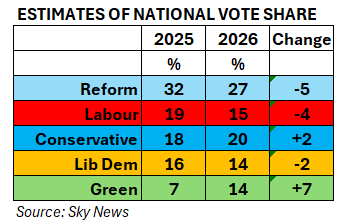
The fact remains that Reform is still out in front. If our only comparison was with the general election result two years ago, Nigel Farage could justly claim that Thursday’s results represent a revolution in British electoral history. But we do have figures from polls and last year’s local elections. They agree that Reform has slipped back from its peak. (Last year Reform won 41 per cent of all seats up for election. Last week their tally was down to 29 per cent.)
There is another feature of multiparty politics that the results have shown, and which Hackney and Havering also illustrate. We have five party politics across England (and six in Wales and Scotland) but in the great majority of localities the battle is essentially between two parties. This explains the huge variety of results.
Normally, the movements in votes in one locality are broadly similar to those next door. No longer. In London’s 32 boroughs, they were all over the place. Kingston-on-Thames is a one-party borough: 44 of its 48 councillors are Liberal Democrats. Next door, Labour consolidated its control of Merton, with the Tories leading the opposition. Cross into Lambeth, and the Greens have thrashed Labour. In the great majority of London boroughs, either one party or two supplies at least 80 per cent of local councillors; it’s just that the identity of the two varies from place to place.
What we are witnessing is a local government version of tactical voting: enough people know which parties are locally strong, and which aren’t, to shape the outcome of each contest. This has potentially huge implications for the next general election. In the 1990s, the Lib Dems established local bridgeheads by winning council seats in different parts of Britain. These bridgeheads gave them credibility when the next general election came along. They helped the party make its big breakthrough in 1997, when their tally of MPs at Westminster jumped from 20 to 46, despite the fact that their national vote share actually dropped.
Something similar could boost Reform and the Greens at the next general election. Two years ago, they won only nine seats between them, despite winning a combined total of 22 per cent of the Britain-wide vote. The next general election is likely to see both a big rise in their total vote, and a greater concentration of that increased vote in their target seats. Thursday’s results have gone a long way to showing voters, and not just party strategists, where they are. The current parliament, in which Labour and the Tories won 532 out of 632 mainland seats, remains a bastion of two-party politics. It is at danger of crumbling as never before.
Given the size of Labour’s landslide two years ago, Starmer has a double reason to worry. It’s not just the party’s terrible national support: 15 per cent on the basis of Thursday’s results, 18 per cent in the polls. It’s also that it is threatened by different parties in different constituencies. In the past, the Tories were the challengers in the vast majority of its vulnerable seats. Next time, Labour will need to fend off significant numbers of Green, Reform, SNP and Plaid Cymru candidates, not just Tories.
Labour, then, is in deep trouble. No wonder its MPs are discussing whether to find a new leader. Starmer’s future was not any ballot paper on Thursday; but in a way it was on every ballot paper. The coming weeks might tell us if he will face a challenge. Catherine West, a former minister, has brought the issue into the open by threatening to stand against Starmer herself.
While the uncertainty persists, we can at least address the question objectively: does changing prime minister in mid-term help or hinder a government’s prospects of recovery?
The two examples most commonly cited are 1976, when James Callaghan succeeded Harold Wilson, and 2007, when Gordon Brown succeeded Tony Blair. Labour went on to lose the subsequent election after both handovers. Starmer’s allies point to this history to warn MPs not to repeat the same mistake. However, as any competent social scientist will tell us, two data points are insufficient to give us a general rule.
We can do better than that. There have been eight parliaments in the past seventy years when the prime minister at the end of the parliament was different from the one at the beginning. Here is the record of what happened at the subsequent general election.
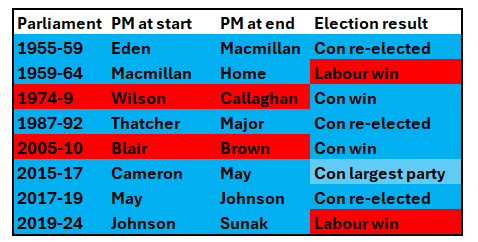
In crude terms, four of those end-of-parliament prime ministers stayed in office, while the other four had were voted out. (Theresa May lost her overall majority in 2017, but stayed in office thanks to the Democratic Unionists. But the Conservatives, with 318 seats, remained well ahead of Labour, 262.)
On those figures, the case for or against a change of PM can be argued either way. However, we should note that both Callaghan and Brown had opportunities to remain in office by calling earlier elections: Callaghan in 1978, before the winter of discontent, and Brown soon after he entered Downing Street in 2007. We can’t be sure that either would have kept their jobs, but it is far from certain that they would have been defeated. Brown enjoyed a three-month honeymoon, when he was ahead in the polls. He considered calling an early election but backed out. In retrospect it was a clear mistake.
In only two of the eight parliaments was the incoming prime minister facing the near certainty of defeat: Alec Douglas-Home in 1964 and Rishi Sunak in 2024. Both of them took over when their party had been in office for 12 years and, unlike John Major in 1992, could not dispel the public mood that it was time for a change. Mind you, in Home’s case, the surprising thing was how close he came to keeping Wilson out.
So there is no clear rule for deciding whether to change prime minister. It’s a risk either way. However, the record suggests some advice for Labour MPs pondering whether to move against Starmer.
1. A new leader must be the champion of change, not the status quo. Major scrapped Thatcher’s poll tax; Johnson sorted out Brexit. (The price we have all paid for his “achievement” came later.) What change could a new leader offer? An ambition to rejoin the European Union? Replacing first-past-the-post with a fairer voting system?
2. A new leader must avoid carrying the lingering odour of their predecessor. Eden had been broken by the 1956 Suez crisis. Although Macmillan had initially backed the doomed venture, he ended up insisting on withdrawing British troops. He escaped blame for launching a doomed war. Major did not just scrap the poll tax, he presented a more emollient and consensual style than Thatcher. If Labour’s new leader is a current member of the cabinet, they will need to work harder on this than Andy Burnham, who is not even an MP let alone a minister or, say, Al Carns who, though a minister, is a fresh face and voice outside the cabinet. The more involved the new leader has been in running Britain for the past two years, the more vital it will be to admit the mistakes made since 2024.
3. A new leader must choose the right date for the next general election. Johnson got this right. Brown got it wrong; so, probably, did Callaghan. May would have got it right had her 2017 campaign not blown up over an unforced error on the politics of welfare reform. The Tories were stunningly successful in the local elections held shortly after the general election was announced; and they remained well ahead in the polls until the last fortnight of the campaign.
I know that this falls short of providing a simple answer to today’s exam question: should Starmer go? Either way, the crystal ball is murky. That’s politics for you. The one thing that is beyond doubt is that settling the leadership issue is just the start of the challenges that Labour MPs face.
This analysis was first published by Prospect
Starmer has never been able to emotionally connect . Those who know him constantly say what a good man he is , integrity , compassion . A man who cares . But he doesn’t know or isn’t able to convey that . He hasn’t got the power of rhetoric which is critical in todays political climate .
A PM can’t hide in the shadows anymore . This is the digital age and we have an analog PM and that will never do in a fragmented and toxic political landscape . Starmer is a builder but devoid of ideology and that isn’t enough when an electorate is divided , nervous and angry about the slow pace of change . It’s not enough to say ‘we know it’s tough for you but hang in there it will get better’ when the person telling you that shows as about as much feeling as an AI Avatar of a brick wall . Starmer can’t tell stories - at least to the general public .
Labour didn’t get it from the very beginning when they got elected that they were still the perceived problem as well as the possible solution . The voters just said ‘well we don’t particularly like you lot but we couldn’t stand the previous bunch . Deliver quick or else’ Well else has arrived .
Winning a landslide on 34% is hardly an endorsement and a gross distortion of reality . Labour were never a new broom they were just the old one in the publics mind with a quick wipe down .
The 2026 election Labour bloodbath was, arguably, McSweeney's final legacy - the roll out, in real time, of a country infuriated by Blue Labour's pathological hatred of the left and it's dogged truly vote-shedding move to the right. The price has been paid.
As for what happens next, we could stay in a multiparty impasse resolved only with PR, or we could move towards a new duopoly as Peter intimates, something that, weirdly, I predicted back in Nov 25 - https://westenglandbylines.co.uk/politics/farage-vs-polanski-the-new-duopoly/