
Reform's support really is down: here's the evidence
The fault, dear Nigel, is not in the polls but in yourselves

Prime minister Farage? The danger has receded… for the moment. For much of last year, polls and elections consistently showed Reform on course to win the next general election. That has changed. Over the winter, the party has lost support, Nigel Farage’s ratings have slipped, and signs have multiplied of voters’ appetite to vote tactically to defeat Reform candidates.
The best way to show what has happened is to combine the figures from a number of polls, and then track the same group of polls over time. The table below averages the figures from the same seven companies since last summer. It shows that Reform has slipped back five points since its peak. (A fuller technical note is at the end of this post.)
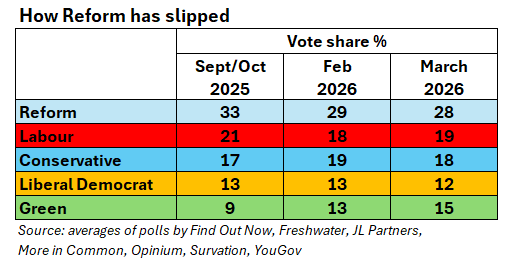
The Green victory in Gorton and Denton hasn’t helped Reform, but most of its decline had already happened. This matters. Sudden changes are often temporary. Steady drifts are more likely to persist. (Note “likely”, not “certain”. As with all poll-based predictions, we are dealing with probabilities, not certainties. I can’t be sure what Reform’s support will be next month. What I do know is that Farage should be worried.)
Over the winter two facts stand out. By last month, Reform was down four points, while the Greens were up by the same amount, following Zack Polanski’s election as their leader. It looks like a straight swing; in fact, these are the net changes of movements to and from each party. However, it’s perfectly possible that a minority have switched directly from Farage to Polanski. They are people whose living standards have stalled and who have lost faith in the traditional parties – but are not yet sure which insurgent best reflects their demands for change.
Since last month’s by-election, the Greens have gained further ground, although there are signs that their bounce may have started to fade. Reform has failed to reverse its slide. Five months ago, Labour was clearly in second place. Now it jostles with the Tories for this place – though, once again, individual polls vary. Most show Labour now edging ahead of the Conservatives, but the latest YouGov and Find Out Now polls show Labour running fourth, behind both the Greens and Tories.
Why has Reform slipped? Farage’s personal ratings are also down – but his fortunes simply track his party’s: they do not help us determine cause and effect. For those of us old enough, a trip 45 years down memory lane gives us a clue to what is happening. In 1981, the newly formed Social Democratic Party, formed by MPs breaking away from Labour, surged ahead in the polls. But the same polls also showed that many of its supporters neither knew what the SDP stood for or supported its signature policies. Over time, its aims became better known, and voters started to drift away.
Something similar may be happening to Reform. At its peak, its support came from two distinct groups – devotees who supported Farage’s distinctive nationalism, not just on immigration but on issues such as climate change. They were the great majority of the 15 per cent who voted Reform at the last general election and have stayed loyal. The second group, who lifted the party’s total above 30 per cent last year, look like a cross-section of the electorate, united by their feelings of insecurity and their hostility to both Labour and the Conservatives, but not by shared opinions, other than on immigration.
As Reform’s agenda has become better known, and more voters become aware of its stumbles in running the counties it captured last May, it has lost a chunk of last year’s shallow converts.
There is another factor, which separates Reform today from the SDP four decades ago. Few voters actively disliked the SDP’s moderation. Reform has not only lost support, it has generated increasing hostility. Last November, and again this February, More in Common asked respondents not just which party they would support, but which they would vote against.
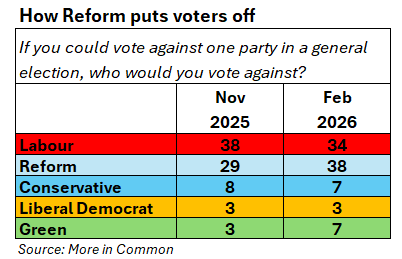
In November, Labour topped the unpopularity chart; now it is Reform that voters dislike most. This helps to explain why Reform is struggling against a double squeeze: fewer supporters, and also the willingness of people, especially progressives, to vote tactically. A recent survey by BMG for the i newspaper found that most Labour, Green and Lib Dem supporters were prepared to vote tactically. Fewer Tories, and far fewer Reform supporters, were willing to do the same.
Two by-elections in recent months have told the same tactical story as the polls – hence the Plaid Cymru victory in Caerphilly’s contest for the Welsh Senedd, and the Green victory in Gorton and Denton. Voters decided that they had the best chance of defeating Reform.
Tactical voting could well cost the party dear at the next election, especially If its support ends up well below 30 per cent. However, this depends on voters knowing which party is best placed to defeat Reform locally. Two years ago, the Lib Dems benefitted greatly from the fact that they were clearly best placed to oust the Tories in their target seats. The problem at the next election may be that there is no such clarity in seats where Reform is ahead, especially where Labour and the Greens are in a tight contest for the anti-Reform vote.
There will of course be various tactical voting websites. It would help if they gave the same advice in every, or almost, every seat. But those sites will depend on seat-by-seat projections made by large scale MRP polls. These surveys may disagree with each other, and so lead to conflicting advice. That would be wonderful news for Farage, bad news for Labour and the Greens.
Meanwhile, the more immediate question is whether Reform can arrest its slide in support this spring. May’s elections in Scotland, Wales, London and many councils in the rest of England will be the next big test. Last year, Reform’s overall vote share – when results from different councils were converted into projections of national support – was 30 per cent (BBC estimate) or 32 per cent (by professors Colin Rallings and Michael Thrasher for the Sunday Times). The yardstick for judging Reform’s performance this time can be reduced to the answer to a simple question. Will its national projected share remain at 30 per cent or above – or will it fall short?
Technical note. Paradoxically, we can be more certain about how far Reform’s has fallen than we can about the level of the party’s support. Different polls use different methods. YouGov’s figures for Reform are lower than those of other companies (I discussed the reasons for this a few weeks ago).
Moreover, individual polls, however carefully conducted, are subject to sampling error. This makes small month-by-month fluctuations reported by single companies unreliable. But by averaging the figures from the same companies, with combined samples of more than 12,000, we are able to minimise sampling fluctuations and make like-with-like comparisons over time.
As a result, we can be confident that the CHANGES shown in the table are fairly accurate. Indeed, polls that disagree consistently about Reform’s popularity, agree that it has fallen significantly in the past five months. Thus YouGov says Reform has slipped from 29 to 23 per cent, while Freshwater reports a fall from 35 to 30 per cent. Pollsters produce different figures for Reform’s level of support, but all seven say it has fallen by broadly similar amounts.
This post was first published by New World
What becomes almost entirely unpredictable is the potential number of seats that could be won at the next general election, the only number that really counts. With more than two parties in the race, and with conventional geographical distribution blurring, FPTP becomes highly unstable,with powerful 'edge' effects. In other words a couple of parties can win say a high-teens vote share and win few seats, whilst at the same another party might win a low-twenties vote share and sweep the board. With the number of parties in the running this sort of wildly unrepresentative result starts to look more likely than not.
Then there is the desperate 'last ditch' of tactical voting. You vote for the party you hate the least in order to lock out the party you fear the most, whilst not actually voting for the party you genuinely support - a highly negative celebration of the democratic process which still further corrodes the already frayed relationship between electors and politicians.
The time for electoral reform is long overdue.
I'm not sure I entirely agree that "Over time, [the Social Democratic Party's] aims became better known, and voters started to drift away." Voters drifted away when the Falklands War started in 1982. I was an SDP member at the time, and I recall canvassing for the party in Wandsworth for the local elections. To begin with, we were listened to, but suddenly people on the doorstep were saying "I'll wait until I see what Thatcher does about the Argies." As soon as the Task Force started to be assembled, the SDP vote evaporated.
I've long been of the opinion that Thatcher would have been a footnote in history (as the UK's first female prime minister) were it not for the unholy and unwitting alliance of Galtieri and Scargill: we might even have had an SDP government in 1984.
Mind you, I do agree you view that Farage's support is ebbing and will continue to ebb away. Shining a light into dark corners always has the effect of showing where the rubbish is.