

Only three times in the party’s history has a Labour government been able to cheer a by-election night as a boost to its prospects of remaining in office.
The first was retaining Kingston-upon-Hull North in January 1966, ahead of its big national victory two months later. The second was four months ago, when Andy Burnham won Makerfield (though some ministers were happier than others).
The third was last night.
Sagal Abdi-Wali has not just defeated the Greens in a local by-election. She has defied history. Four weeks ago, I argued that Holborn & St Pancras was a contest Zack Polanski should win. Going back more than half a century, Labour has a truly dreadful record defending its own seats when it is government and faces a by-election challenge from the left or centre-left. The average swing against Labour in such contests was 24 per cent.
On those figures, Polanski should have won at a canter.
Instead he has crashed. Last night his team crowed that the Greens had trebled their share of the vote. This an example of “paltering”, a useful, underused word for a statement that is technically correct but seriously misleading. I wrote about this last year, with Labour and Conservative examples of this shoddy practice.
The Greens can make their “trebling” claim only because the left-wing vote two years ago was divided between the Greens’ 10.4 per cent and an independent, Andrew Feinstein’s, 18.9 per cent. Together, they won 29.3 per cent. Feinstein stood aside this time to support Polanski, who won 32.8 per cent: a true increase of just 3.5 percentage points.
That’s not all. The same issue arose in Gorton & Denton in February. There, George Galloway’s Workers Party stood aside, having won 10.3 per cent two years ago. So the combined Green/Workers baseline was 23.5 per cent. In the by-election, the Green’s Hannah Spencer won 40.7 per cent, a hefty 17.2 point increase on the combined left-wing share in 2024.
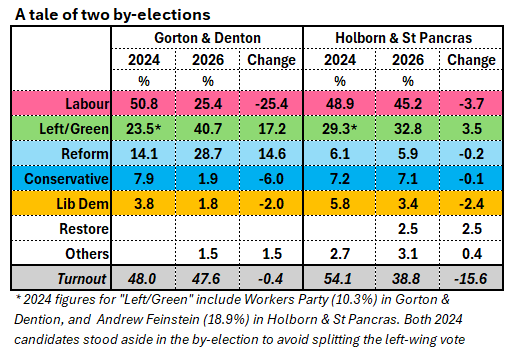
Even that comparison understates the scale of Polanski’s failure. The Greens were so successful in Gorton & Denton that their number of votes jumped from 8,576 for the two left-wing candidates in 2024 to 14,980 for Spencer alone in the by-election.
These are the equivalent figures for Holborn & St Pancras. 2024 combined vote: 11,342; Polanski alone 8,928. In short, the Greens’ record is: up more than 6,000 in February, down more than 2,000 in October.
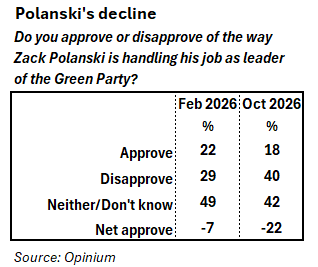
Polanski’s personal rating hasn’t helped him. Opinium found that his net approval figure had fallen from minus seven in February to minus 22 in its latest poll. It puts him level with Nigel Farage as Britain’s least popular party leader. This poll was conducted before last weekend’s vote by his party to define Zionism as racism. Polanski abstained; his reputation is unlikely to have improved. The title of least-liked leader may now be his alone.
The turnout figures contribute to the story. In Gorton & Denton, it was virtually unchanged on the general election; in Holborn & St Pancras it fell from 54 to 39 per cent. As a result, Labour has also suffered a fall in its numbers. It would rather have repeated Andy Burnham’s performance in Makerfield, when both Labour’s percentage and its numbers rose sharply.
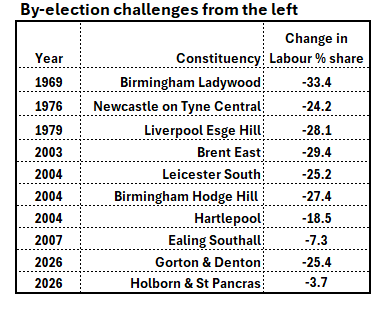
Nevertheless, it was no mean achievement for Labour’s Abdi-Wali. Her share of the vote was down just 3.7 points on the general election. This was the tenth time that Labour has had to defend a seat when it has been in government and the main by-election challenge has come not from the right but from either the Liberal Democrats or the Greens. Abdi-Wali has retained a higher share of the vote than any of her predecessors. Only Virendra Sharma, in 2007, came anywhere near, and he won Southall during Gordon Brown’s honeymoon as a new prime minister.
To set all this in a broader context, the national polls show how Burnham’s arrival in Downing Street has revived Labour’s fortunes. It is hard to measure this accurately by looking at individual polls. The noise from sampling fluctuations can drown the signal.
To dial down the noise, I have taken the averages from the same five polling companies, and compared their voting figures from mid-June (just before the Makerfield by-election) with their latest numbers.
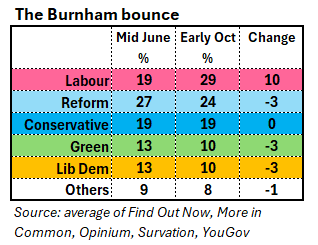
Before Burnham became prime minister, more people supported the Greens ot Lib Dems (combined score 26 per cent) than Labour (19 per cent). Today, Labour is ahead by 29-20 per cent.
As I have argued before, the next general election will not be a simple government-versus opposition affair. It will involve two separate contests, one to dominate the left, the other to dominate the right. Just now, both Reform and the Tories are slugging it out on the right. Labour’s opportunity is to reinforce its dominance on the left of centre.
Here we should consider the Lib Dems and Greens separately. The Lib Dems are in practice Labour’s allies. Two years ago, they gained 60 seats from the Tories and four from the SNP. They gained none from Labour, and only one seat, Burnley, can be regarded as a Labour-Lib Dem marginal. Few if any Lib Dem resources are likely to be devoted to capturing Labour seats at the next election. They will do little or nothing to deter tactical voting.
In contrast, the Greens will be relying on their national campaign to boost their overall vote, and under Polanski they are as hostile to Labour as to the parties of the right. The danger to Labour has been not that they will lose seats to the Greens but that the Greens will syphon of votes that Labour needs to fend off Reform and the Tories.
After last night, and whether Polanski stays or goes, the Greens are less likely to be a threat.
A bracing & positively uplifting read to start the morning. It’s not that I am a huge fan of Burnham (so far) but I do actually despise Polanski and the Nuovi Corbinsti Green entryists!
It’s a good enough result for Labour, but to present it as a triumph for Burnham, and a ‘catastrophic night for Zack Polanski’, is overselling it.
This was always likely to be a Labour hold, being a very safe seat. You can compare it to similar by-elections held after the resignation of former Prime Ministers (Sedgefield 2007, Uxbridge 2023). In both cases the governing party held the seat comfortably enough, but still went on to lose the following general election.