
Brexit is less popular than ever
YouGov's latest poll suggests how Labour can settle its squabbles over rejoining the EU

I bring fresh news of the battle for public approval. Arguments about Europe have erupted at the very time that voters’ hostility to Brexit has scaled new heights.
Over the decade since the 2016 referendum, YouGov has been tracking voters’ views of the outcome. Do we think we were right or wrong to vote to leave the European Union? For the first few months, the results confirmed the outcome of the referendum: a small majority said “right”. Through 2017, and that year’s narrow Conservative victory, views were evenly divided. But from early 2018, more people said “wrong” than “right”. The gap narrowed after Boris Johnson’s election victory in 2019, but widened again after the Covid pandemic. Since July 2022, when Johnson’s premiership imploded, the number saying “right” has stayed below 40 per cent, with “wrong” consistently above 50 per cent.
Last week, YouGov updated their figures. They questioned 2,107 respondents on Thursday and Friday. They found that just 29 per cent said we were “right to leave”, while 58 per cent said “wrong to leave”. This is the first time the numbers saying “right” have fallen below 30 per cent, and the first time that “wrong” has outnumbered “right” by two-to-one.
The table below shows what has happened. More than one in three of those who voted leave in 2016 no longer back Brexit: 23 per cent now think it was wrong, while 13 per cent don’t know. In contrast, just six per cent of remain voters have switched sides, with another six per cent unsure. Fully 88 per cent still think Brexit was wrong.
Those figures exclude around eight million Britons have reached voting age since the referendum. The great majority say Brexit was wrong. In contrast, most of the six million older voters who have died since 2016 wanted Britain out of the EU. (Last December I calculated that even if nobody had changed their minds about Brexit, demographic change alone would have ensured a switch to a pro-European majority across the United Kingdom.)
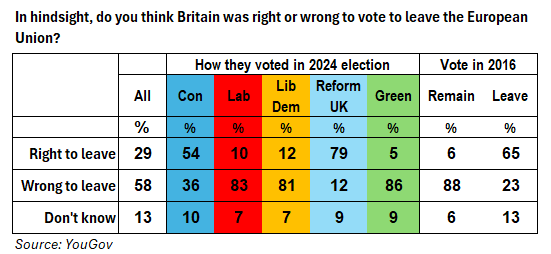
It’s also notable that while Reform voters overwhelmingly back Brexit, Conservative voters are more divided. The centre-right, internationalist ranks of John Major, Michael Heseltine and Kenneth Clarke have virtually disappeared from the House of Commons, but they can still be found in the electorate. Meanwhile, Labour, Green and Liberal Democrat voters overwhelmingly oppose Brexit.
It’s not possible to translate those national figures accurately into the views of the voters of Makerfield. We can, though, make a rough guess. The constituency voted 65-35 per cent for Brexit. If the current views of the two groups are similar to those of remain and leave voters across the country, then both the “right” and “wrong” camps have around 45 per cent support. To be sure, we must allow for a large margin of error. However, it seems likely that neither side can claim a big majority.
What then is a Labour candidate with a pro-European history to do in the coming by-election? While we await the outcome of the selection process, let’s just call her or him AB.
There is plainly no need for AB to claim that Brexit has gone well. Apart from being manifestly untrue, it would contradict the views of the vast majority of progressive voters. But to announce an intention to start talks to rejoin the EU would be to take a risk in a constituency that voted so heavily for Brexit, even if plenty of its voters are disillusioned with the outcome.
However, the bigger reason for not applying now to rejoin the EU is not that it is unpopular, but that it is bonkers. EU countries would be wary of even starting meaningful talks as long as there is any serious chance of Britain electing a Eurosceptic government. This puts the earliest possible date for a plausible application beyond the next general election.
AB can simply tell the straightforward truth, without disowning past expressions of Euroenthusiasm. Whatever anybody’s long-term ambitions for Britain, there is not the faintest chance of the UK applying to rejoin the EU without this being the clear and settled wish of majorities in the electorate and parliament. Even if AB wanted to exploit today’s big Labour majority in order to pursue EU membership, he knows that Brussels – not to mention Berlin, Paris and Rome – would stand in the way.
What AB can do is reframe the question. Just now, it should not be whether to start talks to rejoin the EU – or “betray Brexit” as Farage and the Daily Mail would put it – but how to repair the damage that Farage and his allies have done to Britain over the last ten years. It should be about how to lower the barriers to trade for the benefits of workers, consumers and businesses.
The trend in YouGov’s surveys suggest that this is a battle that AB can win, even in Makerfield. Britain’s long-term destination is an argument for another day, and in any event its final arbiters will not be the prime minister but the electorate.
As a Remainer, I have nonetheless always felt it was offensive to describe Leave voters as wrong. Voters voted as they were empowered. It was the Cameron government that was wrong in not framing a referendum on 2 questions, namely in / out and closeness of relationship with the EU.
Even now I worry about framing Rejoin as a panacea. The UK is increasingly cleft along national lines. And Brexit has at least revealed that the country needs significant internal institutional reform, and national policy stability, something well outside the EU’s remit. There is also a need to face down the ugly expulsion wishes of the Radical Right and to reveal their cloaked attack on the legal protections of all citizens and residents of the UK. In short, a lot more people, especially in England, need to learn that rights do matter to everyone. That needs to be settled before and not during a Rejoin campaign.
Check out our substack that details UK and global election cycles! https://substack.com/@electoralgraph/note/p-198260551?r=8g6ykk&utm_source=notes-share-action&utm_medium=web