

Good morning. Here is the news. Reform has fallen behind both Labour and the Conservatives. Its 18 per cent vote share is the worst recorded by any pollster since November 2024.
Yesterday’s Mail on Sunday carried Michael Ashcroft’s report of his latest monthly poll. It confirmed that Andy Burnham’s bounce is real. Asked who would make the best prime minister, 44 per cent say Burnham, who comfortably outscores Kemi Badenoch (17 per cent) and Nigel Farage (15 per cent).
But Reform slumping to third place? No mention beyond those best-PM numbers. Dear reader, before you complain that this proves the bias of either Ashcroft (a Conservative peer) or the Mail on Sunday, I suggest you wait until the end of this blog.
The voting intention figures can be found in Wikipedia’s table of polls since the last election. As ever, it includes Ashcroft’s poll which, as usual, has a hefty sample of 5,000. It was conducted between July 30 and August 3. It shows Labour four points ahead of the Conservatives and nine ahead of Reform. Here are its figures and how they have moved since the start of the year:
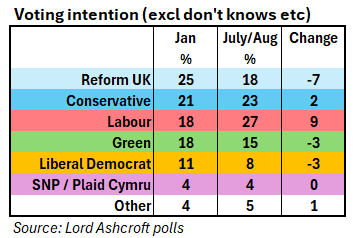
No other pollster has Reform crashing anywhere near so low. Has Ashcroft been unlucky and produced a rogue poll with a large sampling error? Is Reform really doing that badly? My answers are “no” to the first question and “it’s more complicated than that” to the second.
The key to what is happening is the way Ashcroft calculates voting intentions. Every other pollster offers respondents a list of parties and asks them something like: “Which party would you vote for if there were a general election tomorrow?”. The pollsters add up the answers, and report the percentages for each party.
Ashcroft does not ask a single voting intention question. Instead, he asks this about each party in turn:
Q. As things stand today, how likely would you say it is that you will end up voting for each of the following parties at the next election - where 0 means “there is no chance I will vote for that party”, and 100 means “I will definitely vote for that party”.
Ashcroft then counts the total number of people, weighted by likelihood to vote, who give each party a score of 50 or more. In his latest poll, 794 respondents scored 50-plus for Labour, ahead of the Conservatives (679) and Reform (552). And so on. In total, almost 3,000 gave a 50-plus score to one of the seven named parties or “another party”. These figures were then converted into percentages.
Incorporated into Wikipedia’s table for all polls, Ashcroft’s figures appear as if they are comparable to normal voting intention results. In fact, they are not. Ashcroft heads this section of his table: “Current voting intention”. It’s a perfectly legitimate label; and his tables make clear exactly what he is doing. But his way of measuring voting intention is different from everyone else’s.
Which is better? The obvious way to find out is to look at what happened last time. Does this tell us? Sadly, no. In his final poll of the 2024 election, and using the same method as he does today, Ashcroft showed Labour on 38 per cent (3 points too high), the Conservatives on 19 per cent (5 points too low), Reform on 18 per cent (3 too high), Lib Dems on 11 (2 too low) and the Greens on 8 (1 too high).
Most other pollsters erred in the same directions for the biggest parties: Labour and Reform too high, Tories too low. So the record from the last election doesn’t help very much. Ashcroft’s errors were slightly greater than the average of other pollsters, but not by enough to deliver a clear verdict.
Rather than ask which is more accurate today, Ashcroft or his rivals, we should perhaps consider what lies behind the differences. Why does Ashcroft’s method reduce Reform’s support so much?
Here is my hypothesis. Reform’s support is softer than that of other parties. When normal polls ask people which party they would vote for, respondents make a comparative judgement. What we have been seeing in recent months is standard for this point in a parliament. The government is rubbish, the opposition weak, time to protest.
The standard polling question shows that Reform has been the protest vehicle of the past year. But these days, when the same people are asked separately, what do you think of each party?, some of those driven purely by a mood of protest, will withhold high marks from all of them. Conventional polls capture the first sentiment, which lifts Reform up, while Ashcroft’s polls reveal the second, which punctures Reform’s apparent popularity and drags it back down.
The effect is to expose the fragility of Reform’s support. Last winter, when polls showed Reform holding a lead of around ten points over two hated legacy parties, Farage could ride the fragility factor and stay ahead whatever method was used to measure voting intention. Ashcroft’s figures for Reform have been lower than those of other companies all this year, but only now have those weaker numbers combined with Farage’s diminishing reputation and the Burnham and Badenoch bounces to relegate Reform to third place.
A snap election might tell us which polling method is right. As there won’t be an election tomorrow, we can only speculate. My speculation is that the figures from Ashcroft’s polls will eventually converge with those of other companies, as today’s protest voters make their final choice. But where would such convergence lead each party to end up?
Farage should be concerned that his party’s support is too soft for comfort. I doubt it is yet in third place; but it’s heading that way. Ashcroft’s figures could be a lead indicator of a miserable future, as the fragility factor takes its toll.
As always, an insightful, thoughtful and thought-provoking analysis. Thank you, Peter.
I always thought that the 14% Reform got at the 2024 General Election was most likely a high water mark, not a solid base to build on. Almost every time we have an election that changes the party of government, after a week or two, we completely forget just how hated the previous government was, and how willing voters were to vote tactically to eject a sitting MP.
Reform's 14% share reflected that, in many constituencies, they were the main or a main party that could beat a sitting Tory. As such, that share will have included tactical votes. None of the pollsters ask "why" in questions of voting intention. Is it genuine support, or is it a plague on the houses of the two main parties? If we'd have been asking that, perhaps it would not be a surprise now that, because Labour & Tory are performing more seriously, Reform support is falling? I think they were always mainly a home for those despairing of years of identikit policies and now clearer policy differences are emerging, people are happier to support the mainstream parties.