
Four take-aways from Burnham's big victory
And why the polls understated his majority

Before we are consumed by the coming drama of Andy Burnham’s return to parliament, here are four take-aways from last night.
Not just an historic by-election but a remarkable result
The figures are stunning. Like others, I wrote during the campaign that a really good result for Andy Burnham would be that he gathered more votes than Reform’s Robert Kenyon and Restore’s Rebecca Shepherd together. He did not just do that; he had more than 6,000 votes to spare. Nobody saw that coming; and the element of surprise when the returning officer announced the figures has added force to Burnham’s victory.
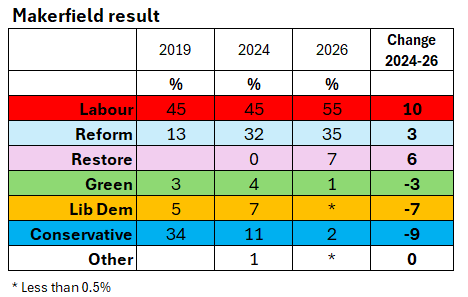
If wavering Labour MPs doubted the impact of having his name on the ballot paper, they need doubt no longer. Whether the impact will be the same when he has been prime minister for three years is another matter, but it is now a stretch to argue that Keir Starmer is better placed to recover the voters that Labour has lost.
The figures are even more startling if we compare the result with the votes cast last month in the council wards that make up the constituency. Reform’s 50 per cent trounced Labour’s 27 per cent. For Burnham to double that is stunning, even after we have discounted the differences between voting for councils and the House of Commons, and the far lower turnout in local elections.
All that said, Burnham has not lifted Labour back to the heights it once enjoyed. When Tony Blair led the party to its landslide victory in 1997, 74 per cent voted for Ian McCartney to be Makerfield’s Labour MP. As in so many of Labour’s industrial heartland seats, the party has lost much of its support in recent decades. A one-off triumph by an exceptional candidate does not in itself stem, let alone reverse, the tide of history. Assuming he becomes prime minister, Burnham will find that a far harder task than winning a by-election.
Burnham defied apathy
Turnout almost always falls in by-elections. Makerfield’s figures are remarkable: a rise of 6.2 points to 58.7 per cent. Not since the Liberals won Torrington in 1958 has turnout risen by more than that.
The high turnout also helped Burnham do something that no candidate defending a Labour seat when the party is in power has done for sixty years. He has not only seen Labour’s percentage rise, he has achieved an increase in the actual number of Labour voters, from just over 18,000 to almost 25,000. The last candidate to do that was Kevin McNamara in Hull North in 1966.
(Douglas Lumsden, the new Conservative MP for Aberdeen South, also increased his party’s vote. He achieved this despite a sharp fall in turnout. It was an impressive result. However, a numerical rise in support in a by-election is less unusual for a party gaining a seat in opposition than for a party defending a seat in government. What is striking is the extent to which Labour supporters seem to have voted tactically for the Tories, putting their common hatred of the SNP and separatism ahead of their traditional dislike of the Conservatives.)
Tactical voting has punished Reform again, and now threatens its future
Makerfield is not just any old target seat. Two years ago, Reform’s 31.8 per cent share of the vote was the sixth highest in Britain. Indeed, its share was higher than one of the seats it actually won (South Basildon and East Thurrock, since you ask). If Reform is to win dozens, let alone hundreds, of seats at the next general election, it needs to win seats like Makerfield by a mile.
Since Sarah Pochin won Runcorn & Helsby for Reform in May last year, Reform has had high hopes of winning three parliamentary constituencies. It has fallen short in all three: Caerphilly (to Plaid Cymru for a seat in the Welsh Senedd), Gorton and Denton (to the Greens) and now Makerfield.
Two years ago the Liberal Democrat and Green candidates won 11 per cent of the Makerfield vote. Yesterday they won just one per cent, setting new records for vote-shedding while they helped to ensure that Burnham beat Kenyon
What is ominous for Nigel Farage is not just those bald facts, but the signs in all three contests of voters deliberately wanting Reform to lose, voting accordingly, and achieving their goal. Such seat-by-seat tactical voting at the next general election would cost Reform dear.
Farage can claim that it has suffered from the intervention of Restore in Makerfield, even though Shepherd’s seven per cent made no difference to the outcome. However, the Restore-intervention argument is double-edged. This week’s YouGov poll for Sky News and The Times puts Restore’s national vote share at four per cent. Its leader, Rupert Lowe, might retain Great Yarmouth, and perhaps one or two seats nearby. Otherwise, its sole impact will be to deprive Reform of victory in a cluster of closely-fought seats – a specific far right version of anti-Reform tactical voting.
The polls: right winner, but wrong majority
Burnham defeated Kenyon by 20 points (55-35 per cent). The poll that came nearest was Convergent (12 points), followed by Survation (10). More in Common and Opinium both reported five-point leads. The four pollsters underestimated Burnham’s support by six to ten points, and overstated Kenyon’s by two to six points.
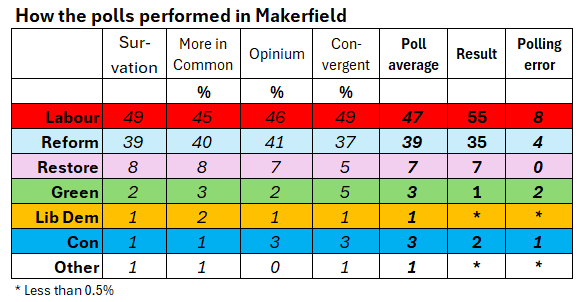
How come? In all three of my posts during the by-election, which can be read here, here and here, I noted something curious about the polls. They all asked respondents how they voted in 2024, and all weighted their published data to reflect the 2024 result. So far, so normal. What I reported was that all the polls significantly overstated Labour’s support at the general election. As a result, they all adjusted Labour’s past and, as a result, present support downwards.
I suggested that the polls all suffered from false recall – some voters misremembering who they voted for in 2024. False recall is a well-known phenomenon. In this case, the problem was exacerbated by Burnham’s landslide victory in the Manchester mayoral election just weeks before the general election. I speculated that the raw numbers for voting intention were more accurate than the weighted numbers.
Looking at Survation’s figures two weeks ago, I recorded its published figures: Burnham, on 49 per cent, ten points ahead of Kenyon. I wrote that
“If..there is nothing wrong with the raw sample, then Burnham now has a 22 point lead (leading Kenyon by 56-34 per cent”
How I wish retained the courage of my convictions. Instead, I went on:
“Mmm. That would surprise me. But I still think Survation’s adjustment for past voting is too big. I would put Burnham’s true support at around 51 per cent and Kenyon’s at 38 per cent. That is somewhere between a best guess and a proper estimate.”
Of the other pollsters, Opinium also published their unweighted voting intention figures. Converted into percentages, they showed Burnham leading Kenyon by 53-35 per cent. I have no doubt that if Convergent and More in Common had provided their unweighted current voting figures, they would show much the same. Despite their small samples, the pollsters got the by-election pretty well spot on – or would have done had they not weighted the raw numbers by (mis)remembered past vote.
Oh well. In the end, like pretty well everyone else, I was surprised; but a bit less surprised than the pollsters and far less surprised than the soothsayers (and not just journalists) who, unlike me, spent time in Makerfield, talked to real voters and described a different constituency from the one revealed by the returning officer.
Postscript: The last time a Labour leader faced the challenge of his leading party opponent fighting a by-election to get back into parliament was in 1984. Tony Benn – like Andy Burnham today – was a former cabinet minister. In 1983 he had lost his seat, Bristol South East. A year later, a by-election in Chesterfield gave him the chance to return to the House of Commons. I was then the political editor of the New Statesman; I went to cover the campaign. Recently, as the Makerfield by-election got underway, the NS reprinted my column. This is how it began:
Vtctor Zorza, the Guardian’s Kremlin-watcher from the mid 1950s to the mid-1970s, was once asked to recall his worst misjudgement. “The Hungarian Uprising in 1956”, he replied. “I went to Budapest and was intoxicated by the atmosphere. I thought it would succeed. If I( had stayed in London reading Pravda and Izvestia, I would have known it would fail.”
Judging a by-election presents much the same problem. Visiting the place provides ample evidence of atmosphere, the anecdotal views of “real” voters, and the horrors of the media circus. It is possible to be right about what is happening, but easy to be wrong. Give me a computer printout from a well-conducted opinion poll any day.
Very interesting comments around the accuracy (or otherwise) of polling versus breathless anecdotal coverage. I canvassed in Makerfield and Reform posters/ garden stakes were much more evident than Labour’s, but I was struck by the number of people (predominantly women) who were quietly horrified at the prospect of a Reform MP.
Thank you Peter, what a fascinating and for me welcome result!