
Makerfield update: Burnham's chances of a big win
Tactical voting has increased his lead – IF the latest poll is right

BBC News reports that “Sir Keir Starmer has told supporters he will stand in any Labour leadership contest that is triggered”. Of course he has. He would be mad to tell them anything else. Any hint that he might step down would instantly make him a lame duck. It doesn’t mean that he will fight on come what may, just that it is too early for him to admit the faintest possibility of defeat.
Like the rest of us, only with much more at stake, he is waiting to see what happens in Makerfield. There are, essentially, three possible outcomes.
First, Andy Burnham enjoys a big win. On this occasion, “big” has a specific meaning. Burnham’s vote would have to exceed the combined support of Reform’s Robert Kenyon and Restore’s Rebecca Shepherd. In last month’s local elections, Makersfield backed Reform over Labour by 50-27 per cent. For Burnham to regain Labour’s lead over the combined forces of the far right would be a huge achievement.
A demonstration of such popularity would impress Labour MPs and put pressure on Starmer. We can expect fresh polls of grassroots party members to follow. Three weeks ago YouGov found that Burnham would defeat Starmer by 59-37 per cent in a head-to-head leadership election. If that lead is maintained or extended, would Starmer risk humiliation by fighting on?
The second possibility is that Burnham wins the by-election but more narrowly. He would owe his victory to the division between Reform and Restore. He could be less able to claim he has fully vanquished the far right. Back in parliament, he would still be able to challenge Starmer and would probably do so. But Starmer and Labour MPs might view the state of play differently. The narrower Burnham’s victory, the greater the case for Starmer fighting on.
One certain thing about any Burnham victory, whatever its size, is that it would be a disaster for Reform. Polls and last month’s local elections show that its support has slipped since last summer. Insurgent parties need momentum. Another defeat, coming after it lost in Gorton & Denton, would feed the perception that Nigel Farage’s party has lost its mojo. This would not only cheer his mainstream opponents; it would give a fillip to Rupert Lowe, the leader of Restore. Reform has been ahead in every poll for the past 13 months. A Burnham bounce for Labour, combined with a rise in support for Restore, would dislodge Reform from top place.
Thirdly, Burnham might not win at all. If Kenyon becomes Makerfield’s MP, Reform’s future would be much brighter – and so might Starmer’s. Burnham could not challenge him. The same YouGov survey that showed Starmer losing to Burnham also showed him trouncing Wes Streeting by 65-15 per cent. He would also defeat Ed Miliband by 58-38 per cent. A contest with Angela Rayner would be too close to call: Starmer’s two-point lead is well within the margin of error.
The prime minister’s greatest short-term threat would be from Rayner. If she decides the time is not yet right, Miliband stays on the sidelines and Streeting fears that a heavy defeat would be bad for his future prospects, then Starmer carries on.
What, then, are the chances of each of those three scenarios for the Makerfield by-election?
Two weeks ago, Survation found that Burnham led Kenyon by just three points, 43-40 per cent. I discussed this poll two weeks ago. I argued that it underestimated Burnham’s support. Looking at Survation’s detailed data I reckoned that Burnham’s true lead was ten points.
Survation has now conducted a second poll. It puts Burnham’s lead at…. ten points.
So: has Burnham’s lead really grown, or is the apparent shift the product of statistical tweaks?
It’s a bit of both. Survation’s first poll reported that Labour supporters were significantly less likely to turn out than Reform supporters. I argued that this was the because of defects in the way Survation designed its questionnaire. If we assumed the same turnout rate for the supporters of both main candidates then Burnham’s lead would have doubled to six points.
The questionnaire in the latest poll is better. Hey presto, it finds that the “certain to vote” figures for Labour (91 per cent of all its supporters) and Reform (89 per cent) are much the same.
This means that, if we assume that the turnout rate among Burnham’s supporters matched Kenyon’s all along, then the increase in Burnham’s support in the latest poll is been not seven points (three to ten) but four points (six to ten).
When we make that adjustment to the first poll, the story of the by-election so far becomes clear. Tactical switching is underway. At the general election two years ago, the Greens, Liberal Democrats and Conservatives together won 22 per cent of the vote. At the start of the by-election campaign, the figure was already down to ten per cent. Now it is just four.
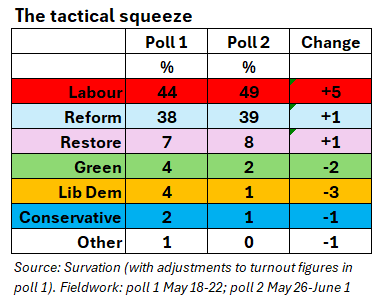
The five-point rise in Labour’s support in the latest pollmatches the fall in Green and Lib Dem support, while smaller changes have seen Reform and Restore up and the Tories down. Overall, tactical voting is helping Labour more because it has now enjoys a near-monopoly of the progressive vote (49 out of 52 per cent), while Reform has been unable to squeeze Restore’s support. The overall left-right balance has stayed the same: Labour plus Green plus Lib Dem remain on 52 per cent, while Reform plus Restore plus Conservative amount to 47 per cent in both polls. (The figures in the table for poll 2 add to 48 per cent due to rounding.)
There is one more point to explore. Two weeks ago I suggested that there was a second problem with Survation’s figures. Its raw sample seemed to contain too many people who had voted Labour in 2024, and too few who had voted Reform. Survation dealt with this by adjusting Labour’s figure down and Reform’s up. I argued that these adjustments could have been a mistake. The raw figures looked to me like the result of false recall (some people who voted Reform “remembering” that they had voted for Burnham – who had been re-elected as Manchester’s mayor weeks earlier). In short, Survation’s raw sample might have been better than it thought. If so, it made the wrong adjustments for voter recall. I estimated that the true position then was Burnham 47 per cent, Kenyon 37 per cent.
The latest poll has different raw recall figures – even more people “remembering” voting Labour and even fewer “remembering” voting Reform. It is just about possible that the publicity from the early stages of the by-election has resulted in yet more people wrongly recalling that they voted for Burnham two years ago. If that is the case, and there is nothing wrong with the raw sample, then Burnham now has a 22 point (leading Kenyon by 56-34 per cent).
Mmm. That would surprise me. But I still think Survation’s adjustment for past voting is too big. I would put Burnham’s true support at around 51 per cent and Kenyon’s at 38 per cent.
That is somewhere between a best guess and a proper estimate. Survation’s samples – around 500 in both surveys – are prone to sampling error. Moreover, the latest poll was completed before the disputes over Farage’s call for “pure, cold rage” following the death of Henry Nowak. We can’t yet tell whether that row has affected Kenyon’s prospects in Makerfield – and, if it has, in which direction.
Even if Burnham does win next week, the size of his majority is far from certain. Right now, I reckon that a big win, as defined at the start of this post, is more likely than not; but I wouldn’t bet money on it. I would feel more comfortable if the next ten days gave us more polls conducted by more companies.
Or we could all just wait until the early hours of June 19, when the votes are counted.
Really useful breakdown as the 10-day countdown begins. The variable that might break these turnout models over the next ten days isn't just false recall - it's the financial shock breaking over the electorate this morning.
With Brent crude hitting $97.60 and Savills officially reversing its property outlook to a 2% decline, voters will be walking into the polling booths absorbing a massive hit to their cost of living. If Burnham does win big, he'll prove a Labour candidate can hold a heartland seat against Farage while under a brutal macroeconomic squeeze - but even then, a messy leadership transition right as inflation spikes risks driving up mortgage and borrowing costs before the new PM even takes over.
You also need to factor in Kenyan's self-declared "sexism", so clearly aired in the latest BBC QT. This is anecdotal but I heard that Makerfield campaigners have, in the last few days, struggled to find any women still wanting to vote for Kenyon.
Whether this is strictly true or not, the light thrown on Kenyon's social media should further increase the gap between his and AB's popularity.
On the other hand, Reform are doubtless saving up some mega-sh*t anti-AB stories to throw out during the final hours where they could have the most impact for the undecided. It's all to play for ...